Agentic Vision: Cameras See Everything, Almost Nothing Acts
Most camera networks record far more than anyone can watch. Agentic vision closes the gap between detection and decision, with agents and operators in one governed loop.
Computer Vision
Currently building at Bluink Labs, agentic vision intelligence that turns existing camera feeds into decisions for defence, manufacturing, logistics and energy operations. Before this, I spent just over a year as the primary AI engineer at Saptang Labs, building ML inference pipelines, embedding search, and transformer-based NLP services for government intelligence platforms. I also spend time on independent work: GLOF prediction from satellite imagery, quantum circuits for intrusion detection, real-time fact-checking on live broadcasts. Most of these were hackathon entries that ended up winning.
GitHub ResumeAugust 2023 - Present
DPIIT-recognised startup (DIPP143482) building agentic vision intelligence for the physical world. Neonet onboards existing cameras, reads plates, vehicles, people and crowds live, joins sightings into tracks, and lets AI agents and human operators raise alerts, search footage and draft reports in one governed loop, with roles, site-level access and a full audit trail.
June 2025 - July 2026
Sole engineer on Altair, a forensic intelligence platform (JWT gateway, 5 FastAPI services, Celery workers, React frontend, 5-database polyglot persistence) built zero to production. Also built the ML layer for Coastal Surveillance, a 5-service, 7-database multimodal platform with face recognition (InsightFace, DBSCAN clustering, Qdrant), object detection (Florence-2), and multilingual OCR across 14 languages. Shipped Nucleus, 11 transformer-based NLP packages (entity extraction, sentiment, translation) served via Gemma 3 12B on vLLM/Ollama, and a LangGraph report-generation agent that cut turnaround from days to ~25 minutes.
March 2024 - August 2024
Built supervised ML models end-to-end (Linear/Logistic Regression, Decision Trees, Random Forest, KNN, SVM, XGBoost), covering preprocessing, feature engineering, cross-validation, and hyperparameter tuning.
2026 - 2028
Building a foundation in corporate finance, investment analysis, financial markets, and risk management, complementing the engineering background for startup economics and capital allocation decisions.
November 2022 - April 2026
Studied biotechnology, genomics, proteomics, metabolic pathways. Taught myself systems programming, ML, and cryptography alongside. Most applied experience comes from production work at Saptang Labs and the independent projects listed below.
2023
CS50 AI from Cambridge. Economics of Banking & Finance Markets and Operations & Supply Chain Management, both from IIT Kanpur. International Trade from IIT Roorkee.
Here is some of my recent work, production systems, hackathon builds, and independent research.

End-to-end pipeline for glacial lake outburst flood prediction. Sentinel-1 SAR imagery is processed to track surface deformation; temporal sequences are modeled through an LSTM to capture ice-melt dynamics. XGBoost classifies risk levels on fused feature vectors. An ESP32 sensor array (water level, temperature, flow rate) provides real-time ground truth calibration. Downstream module simulates water flow to compute evacuation corridors and time-to-impact estimates. Won C-DAC HimaShield Grand Challenge 2025 (Rs 5,00,000). Covered in Press Information Bureau release.

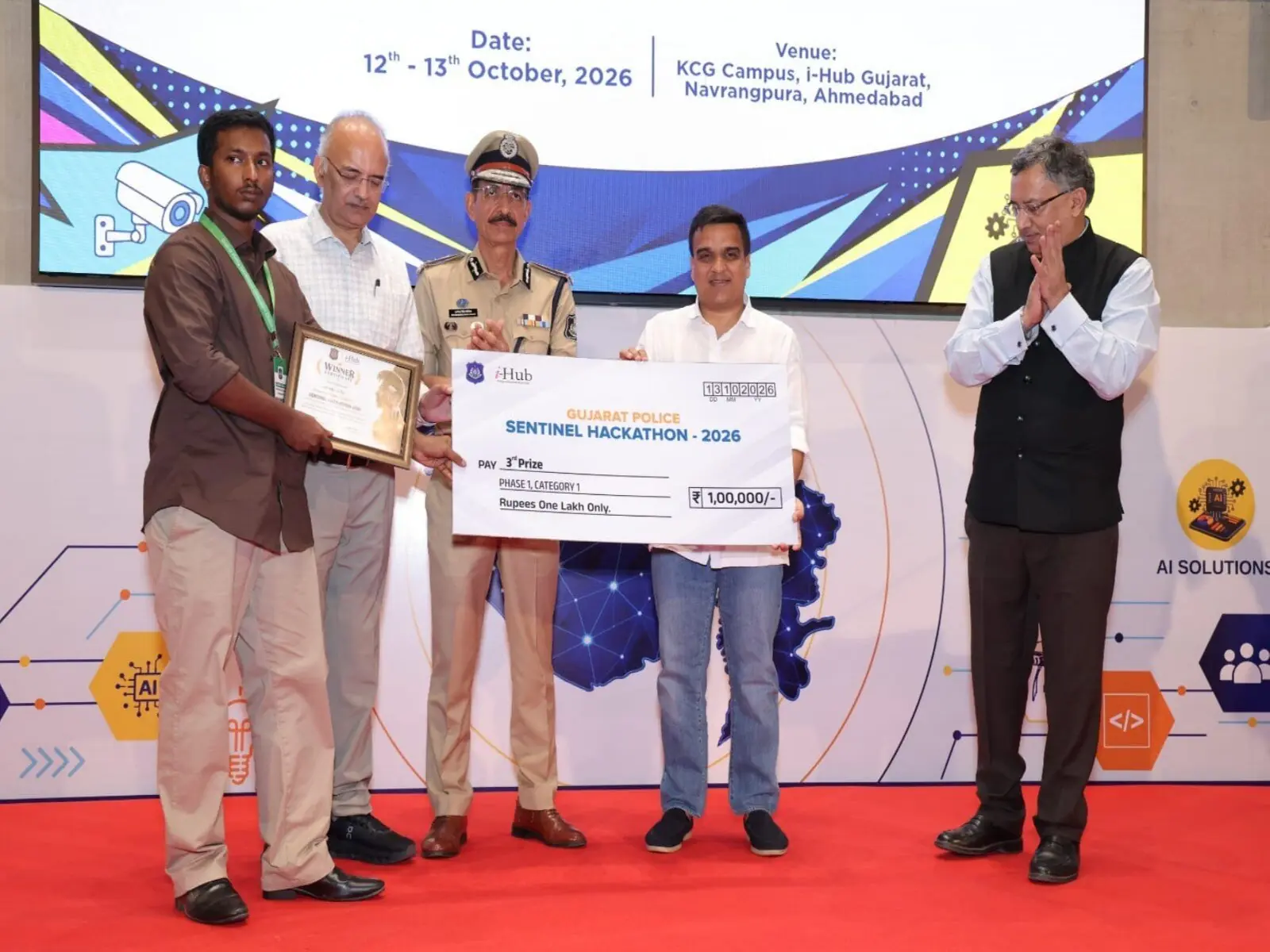
Hybrid quantum-classical intrusion detection system. A 4-qubit variational quantum circuit (PennyLane, angle embedding, strongly entangling layers) is trained on CICIDS NetFlow features and benchmarked against XGBoost and LightGBM. The objective was to evaluate whether parameterized quantum circuits offer any advantage on non-linear decision boundaries in high-dimensional traffic data. VirusTotal API handles IOC enrichment and threat correlation. Stack: Next.js frontend, FastAPI backend. 3rd Prize, Indian Army Terrier Cyber Quest 2025.

Streaming pipeline for misinformation detection in live broadcasts. FFMPEG ingests TV/radio feeds, Whisper handles ASR with timestamp alignment, DistilBERT extracts verifiable claims from transcript segments, and Google Fact Check API cross-references them against indexed databases. Claims are scored with confidence metrics and surfaced on a Streamlit dashboard with source attribution. Designed for newsroom and regulatory deployment. Winner, NFSU Forensic Hackathon 2025 (Rs 1,00,000).

Privacy-preserving identity verification over Aadhaar credentials using ZK-SNARKs. Circom arithmetic circuits with Groth16 proving system let users attest to predicates (age ≥ 18, valid document, state residency) without revealing the underlying data. Proof generation in-browser via WASM in ~500ms, server-side verification in ~10–50ms, proof size < 1KB. The goal is to replace KYC flows that needlessly consume private data with a single boolean attestation. Designed around DPDP Act 2023 requirements.

Consent management layer built on the same principle as Xylem: if a workflow only needs a yes/no answer, it should not require raw personal data. Implements field-level access control, versioned consent records with cryptographic audit trails, and automated DPDP Act compliance reporting. API-first architecture, consent policies are defined as code with pluggable storage backends.

Binary classifier for the GST Hackathon, trained on ~700K taxpayer records with 21 attributes to detect fraudulent filings. Pipeline: missing-value imputation, feature scaling, RandomizedSearchCV over 100 iterations for hyperparameter tuning. Evaluated on accuracy, precision, recall, F1, AUC-ROC, log loss, calibration curves, and cumulative gain/lift charts. SHAP feature importance analysis identifies which attributes are most predictive of fraud.

Daily open source contribution discovery and workflow tool targeting ZKP and Rust ML repositories. Scans 10+ repos across arkworks, SP1, EZKL, Candle, and Burn, fetches open issues via GitHub CLI, scores them by contributor-friendliness (labels, keyword matches, comment count, assignee status, recency), and generates ranked markdown digests. Includes a shell-based workflow helper that automates fork, clone, branch creation, and draft PR submission. Designed to reduce friction for sustained open source contributions.

Autonomous AI agent that manages the full lifecycle of tokenized real-world assets on Hedera. A single natural language command tokenizes a bond; the agent then orchestrates KYC/OFAC compliance screening, coupon distribution, NAV updates, regulatory reporting, and maturity settlement, executing each stage without further human input. The goal is to collapse the operational layer that traditionally surrounds bond issuance into a single agentic loop. 3rd Place, Hedera Hello Future: Apex Hackathon (DeFi Track, $8,000).
Notes on things I've built, broken, and figured out.
Most camera networks record far more than anyone can watch. Agentic vision closes the gap between detection and decision, with agents and operators in one governed loop.
Computer VisionEncryption-at-rest, access controls, and breach-response playbooks treat PII exposure as a storage problem. The real fix is structural: stop collecting what you can prove without.
PrivacyWhy most KYC flows only need a boolean answer, and how ZK-SNARKs, STARKs, and Groth16 can replace raw data sharing, with implementation tradeoffs.
ZK ProofsIf you want to talk about AI, ML, or cryptography, reach out.